
Blog
Holding the hand of AI in usability testing
Dolores Mäekivi, UX Researcher at Bolt, wrote her test method into skills.
How does usability testing change when a user researcher writes her method into Claude skills?
On 22 October I talked with Dolores Mäekivi, UX Researcher at Bolt, about how she runs usability tests today. Jochen Ade, my co-founder at Podojo, and I gave her a first introduction to Claude in early 2026. Since then she has written her own skills, and they now cover the whole cycle of a usability test: the study plan, a quality check of the sessions, the analysis, the report and the showreels for stakeholders. Another skill reviews a prototype before it goes to real users and produces a prioritised list of likely usability issues. It learns from what Dolores has found in her earlier tests. Based on that list, designers often make some small changes before the first participant sees the prototype. Most of her tests now run unmoderated.
Dolores works from Claude, and her skills integrate with our CLI and MCP connector, which link them to our UX testing agent. Because MCP and skills are open standards, this also works in other agentic frameworks. Other customers use Langdock, for example. Dolores' skills plan and analyse the tests, which the agent runs and transcribes. Her process starts with a kickoff call in which a designer shows her the prototype. The agent turns the call recording into a transcript, and from that a skill drafts a study plan with tasks and criteria for success and failure. Once she has edited the plan, a second skill sets up the unmoderated test. Behind that skill, our agent integrates the prototype into our test app, puts the test together and launches it. It can also moderate discovery interviews itself, which is still in early access. The agent records what a participant says while thinking aloud and what they do in the prototype, so her skills can pull both into Claude.
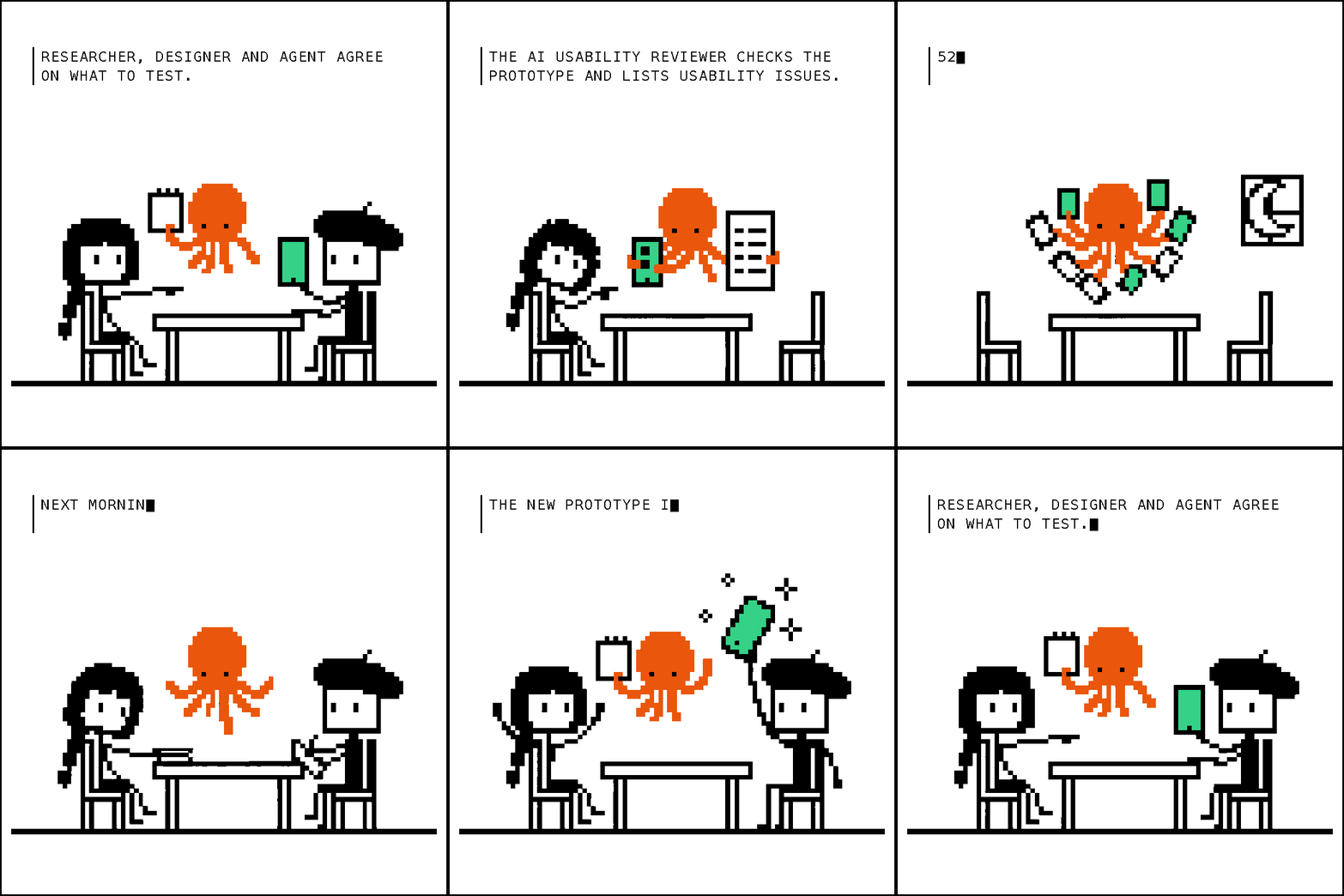
The analysis runs in steps. The AI does one step, she reviews it, then it does the next. "I don't just ask it to do the analysis and then receive the results in the end," she told me. "I, like, hold the hand of AI, so to say, throughout the process."
Trust and time
At first she was sceptical. Her thought was "no way it's going to do my job," and at the beginning she spent a lot of time editing what the AI produced. That changed when she began to train her Claude skills. After the AI had drafted a study plan, she gave it her own final version and asked it to compare the two and learn from the difference. The skills got much better, and her trust grew as she checked their work.
For every participant, the AI rates whether a task succeeded or failed, marks the ratings it is unsure about and puts exactly those clips into a showreel, which Dolores watches before she corrects a rating where needed. "When I see it over and over again that it marks correctly, that makes me, like, actually trust its result and feel more positive about it." Editing is still part of the job, and in our call she said she is not "100% loving it" yet. She usually edits the report quite a bit, and sometimes the AI lists limitations of the prototype as usability issues. A few weeks later I asked her how she handles those. "I just ask the Claude chat to remove these parts from the report," she wrote. Her next step is to copy the report into a Google Doc and make the last edits there, without AI support. "I always see that last human review and edits are needed, e.g. sometimes wording is very machine-like."
The time per test has changed. "When I came, then usability testing took 40 hours and now it's 15," she told me. Unmoderated testing only became practical for her team with AI. Before, they would have tested moderated, because the unmoderated tools were not good enough. Now they run more tests.
What the AI sees
"One thing I think is very helpful with AI," Dolores said, "is that it actually notices more nuances in user behavior than human eye would. ... I think it spots some more nuanced frictions than I would be able to." People tap around fast in a mobile prototype, she explained, and "no way I would be able to capture all of those small interactions." I asked how often that happens. "I think it's in every study. Yeah, it's like systematically because it's so thorough. It goes through every transcript and notices some small things."
After our call I asked her for an example, and she wrote one down for this newsletter. In a recent test of a car rental booking flow prototype, fuel and parking were included by default, and she asked people to book a car without them. To remove them, they had to tap the option's card. "The AI noticed that several participants tapped the card and got an information pop-up instead, because a small info button sits on that same card." They closed the pop-up and tapped again, a matter of seconds, and everyone finished the task. "Watching recordings myself I missed this," she wrote. Across the sessions the same detour kept appearing, which showed that the info button is too close to the tap target. "That's the kind of friction I mean: it doesn't stop anyone or show up in the success numbers, and you only see it by thoroughly looking through all the sessions."
This surprised me. When we talk about AI in research, I think we mostly picture it doing our job the way we do it, only faster. I called it a new perspective, an AI that sees more, and she agreed. One thing she has learned is that the AI needs very good guidance to do good work. Before every analysis she spells out, task by task, what success and failure look like in a recording. Without that, she said, the AI draws its own conclusions and the outcome is poor.
Designing a skill set for colleagues
Her method lives in skills she keeps training, and designers can run them. Whose knowledge is it when it keeps working without the person who wrote it down? I followed that question back to Karl Marx in a LinkedIn article (in German). I asked Dolores whether she is afraid that designers will not need her anymore. "Not afraid at all," she said. She has discussed this with her manager, and they see it as the ideal outcome, because then she "can start doing more meaningful work, more like strategic exploratory UX research." She added: "Nobody wants to do usability testing forever. So it's actually a good thing if I'm automated."
What interests me most is the role she has taken on. Dolores designs a skill set: her method, written down so that the AI can run it and colleagues can use it. In The future of customer research I described skills as methodological knowledge turned into reusable instructions. She shared the skills inside Bolt as a Claude plugin. "I had this wow moment at the beginning, for sure, when I created the plugin and like, oh, actually, everybody can so easily use my skills." So far only a few colleagues have tried them, and she has had little feedback on how the skills work for others. To me, she is building an internal product for her colleagues, and what it needs next is a feedback loop with the people who use it.
If designers take over more of the testing, she sees herself training them at first in moderated and unmoderated testing with the skills, including where to trust the AI and where not. She would also review their reports. Whether designers will have the time to take it on fully, she isn't sure. I think most steps of her own workflow now run with her skills. The harder step is turning it into a service designers can use with her help for their own tests, and that is still open.
In the long run she expects usability testing to need much less of her. I see strong demand for strategic research and field studies in new product development. Her team has been discussing doing more field studies, and she described what that would mean: "go to airports or places where people are ordering taxis, where people take scooters, where people order food, spend time with drivers and couriers. I think this thing is something that AI can't do."