
Blog
What my father the diagnostician knew about product taste
My father trained his diagnostic intuition by standing next to thousands of cases. Product taste works the same way — and that is exactly why it can be taught.
My father was a physician, an internist to be precise. Medicine is a science, and a rigorous one. It runs on evidence, on measurement, on studies that get overturned when the data says so. And yet, at the bedside, with one patient in front of you and the labs not back yet, a lot of what decides the outcome still rests on something we like to call intuition. He told me once, long ago, that after finishing his studies he always tried to get into the largest departments he could find, so he would see as many cases as possible. He was relentlessly curious. He shaped a motto I still carry: that learning and knowledge are the real capital, the one thing nobody can take from you. Maybe that came from his own history. My parents fled the GDR for West Germany, and when you leave like that, you take very little with you except what is in your head.
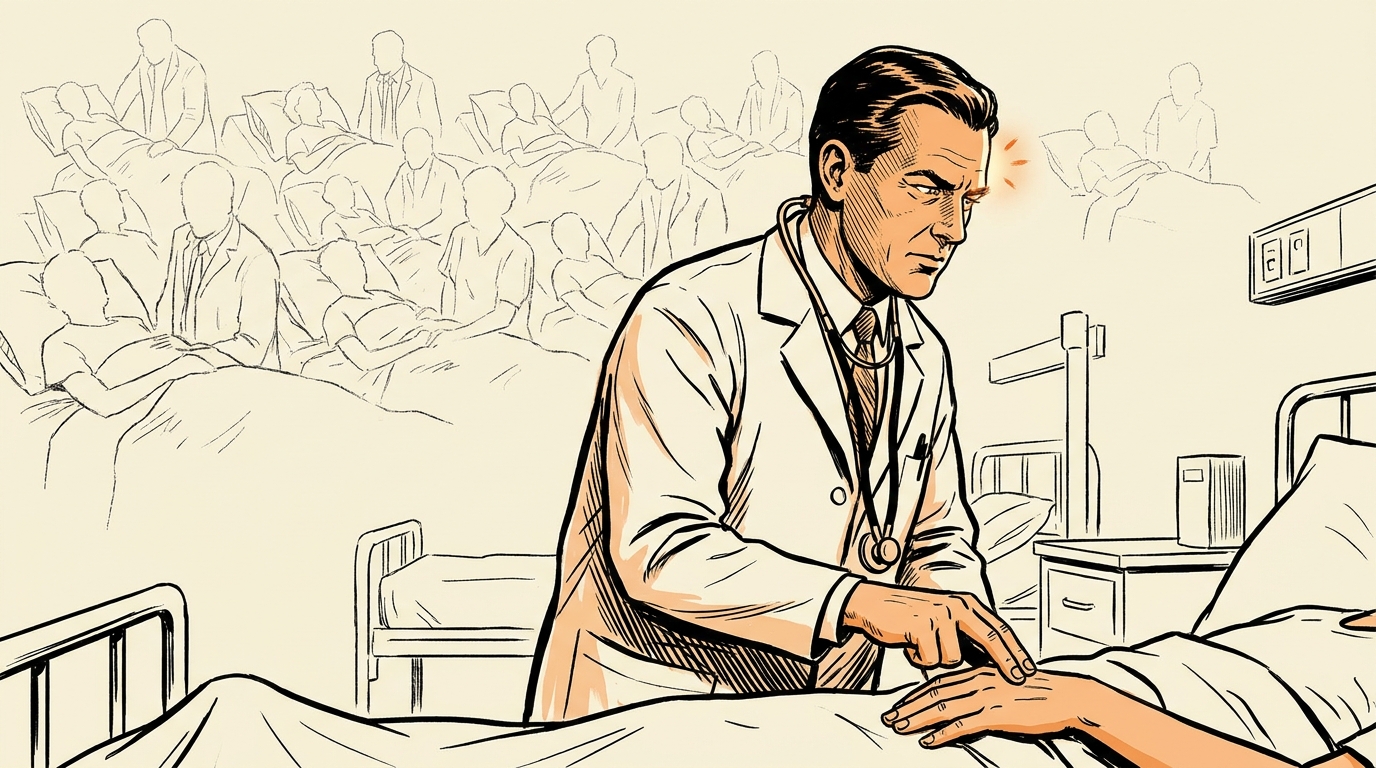
Without ever analyzing it in those terms, I think my father did one essential thing in those crowded departments. Through exposure, through watching, through being present case after case, he was training his intuition. Diagnostic skill is everything for an internist, because illness rarely shows up the way the textbook describes it. He was, by every account I have, an extraordinary diagnostician, and he trusted his gut more often than not. That gut was not a gift. It was the residue of thousands of cases he had stood next to, early in his career, when he chose volume over comfort.
I have been thinking about that a lot lately, because the product world has rediscovered a word for the same thing. We call it taste.
What we actually mean by taste
Taste has become a fashionable word in product circles, and like most fashionable words it has gone soft at the edges. So let me try to be precise about it, because everything that follows depends on it. As long as taste stays one vague word, it stays a mystery you either have or you don't. The moment you can say what it is made of, it becomes something you can learn.
There are really two faculties hiding under the one word, and keeping them apart is what makes the thing teachable at all. Taste is a calibrated sense of quality, the ability to recognize what good looks like. Judgment is the decision you make under uncertainty and tradeoffs, what to build, what to keep, what to cut, what to ship. Taste evaluates the artifact. Judgment makes the call. Taste feeds judgment, and judgment without taste is just confident guessing.
My father's eye for a diagnosis was taste. His decision to act on a hunch before the labs came back was judgment. The two travel together, but they are not the same muscle.
The reason taste feels mystical, and the reason it makes a lot of smart people roll their eyes, is that it is tacit. Michael Polanyi put it in eight words sixty years ago: "we can know more than we can tell." The inputs to an expert's call, the prior cases, the half-remembered patterns, the things their hands learned before their language did, are invisible to anyone watching. So we name the residue taste, and the naming makes it sound like something you either have or you don't.
Christina Wodtke says it more plainly than anyone: "Product sense is intuition, intuition is compressed experience, compressed experience comes from having lots of experience." That is exactly what my father was looking for in those crowded departments. It also quietly settles the oldest argument in the room. Taste is not simply a gift you are born with. Most of it is compressed experience, and anything compressed from experience can, in principle, at least partly be trained. I do believe people start from different levels of aesthetic sensitivity, and some baseline of it is probably the precondition for ever developing a good one. But the part that decides most of the outcome is the reps, and the reps are something we can work on.
The skeptics are right about the word
Here is where I want to hold two truths at once, because I think both camps are partly correct and the fight between them is mostly a misunderstanding.
Jeff Gothelf and Josh Seiden have lately been arguing that taste is fog. Seiden calls judgment and taste "shitty terms that non-experts use" to describe the craft of product and design. Their worry is real and worth taking seriously: when outsiders cannot see the invisible inputs, they reach for a mysterious quality, and that fog makes the work "inexplicable, unteachable, and therefore unfundable." Practitioners get treated like sommeliers instead of practitioners. In a year of AI-driven reorganizations, a capability you cannot explain is a capability you cannot defend.
I think they are right about the word, and wrong about the conclusion. The problem is not the capability. The problem is using taste as a terminal explanation, the place the conversation stops. "She just has great taste" explains nothing and teaches no one. The fix is not to abandon the skill. The fix is to decompose it, to name the sub-skills underneath the word and the behaviors you would actually see.
And once you do that, taste stops being fog. You can watch someone reason from a real user's job instead of a feature. You can watch them spot a weak spec before they can fully say why. You can watch them name what a brief leaves unspecified, make an explicit call when the evidence is thin, and explain the why in language that survives a second reading. None of that is mystical, and all of it is observable. That is enough to teach it.
Whether it is also measurable is a different question, and one I am less interested in than Gothelf is. Maybe a psychology lab could put a number on someone's taste with the right experiment. But the demand to make it measurable mostly comes from the need to make it fundable, and I think chasing the metric can quietly replace the thing it was supposed to track. Taste does not become real because you scored it. It becomes real because someone can now see what they could not see before.
Why data is not enough
There is a more empirical, more data-driven school of product management that I have a lot of respect for, and one quiet disagreement with.
Data is wonderful. It is also, by definition, a record of the past. Every dashboard, every cohort chart, every test result tells you what already happened. For the future, you need something else. You need the ability to work with very low signal and to build a coherent picture out of it that is not random, not hallucinated, but grounded in the few weak signals you do have. That is the part data cannot hand you, and it is precisely the part that decides whether a product bet is any good.
And even the data you could have comes at a price. In medicine you can almost always order another test, but every test costs money, and more often it costs time you do not have, because the patient in front of you needs a decision now. Product work runs on the same trade. You can spend a fortune and months gathering evidence until the picture is airtight, and by then the market window has usually closed, or the cost of being that certain is higher than the bet was ever worth. So you act on less than you would like. You lean on a trained gut, not because the data is worthless, but because waiting for all of it is its own kind of mistake.
My father did not have a dashboard for the patient in front of him. He had a handful of weak signals and a trained sense of what they tended to add up to. Good product judgment lives in the same place. Gary Klein, who studied how firefighters and nurses and commanders actually decide, found that experts rarely compare a menu of options. They pattern-match one workable move and mentally simulate it. The expertise is not in the comparison. It is in the pattern library that lets the right move surface at all.
This is also why I think the skill matters more now, not less. When the cost of producing output collapses, the scarce thing is no longer the output. It is deciding what is worth producing and judging whether it is any good. Cat Wu, who leads product on Claude Code, put it cleanly: "As code becomes much cheaper to write, the thing that becomes more valuable is deciding what to write." Andrej Karpathy described working with these models as directing "ghosts" that "require a new kind of taste and judgment to direct," and added the line I keep coming back to: "you can outsource your thinking, but you can't outsource your understanding."
So the more capable the tools get, the more the binding constraint moves toward the one thing the tools cannot do for you. Which brings me back to the only question that ever really mattered: if this is the skill, how do you actually build it?
How you train an intuitive muscle
Every craft that has actually solved the transmission of taste, and a few have, runs more or less the same loop. Sommeliers, chefs, writers, design studios, the case method at business schools. Strip away the surface and the engine is the same: exposure, then feedback, then articulation, then calibration.
Exposure builds the pattern library. Many examples, good and bad, plus direct contact with the people you are building for. Guillermo Rauch calls this "exposure hours" and makes it almost embarrassingly concrete: quantify how much time you spend watching people actually use what you make. Bob Baxley names the trap that makes this hard for software people: "Filmmakers go to a theater, comedians to a comedy club. None of us have an obvious way to go watch people use software." The exposure that a chef gets for free, an engineer has to go out and manufacture.
Feedback has to be fast and honest, or the reps train nothing, or worse, they train overconfidence. This is the part the day job quietly withholds. You write a spec, and you learn whether it was any good months later, if you ever learn at all. My father got a steep, fast feedback loop because medicine forced one on him. Most product work does not. Someone has to build the loop on purpose.
Articulation is the beat that exposure-only training skips, and it is exactly what Gothelf is demanding. The moment you force someone to say why, out loud, in defensible language, you convert the tacit into something explicit. That articulated why is two things at once: it is how taste gets transmitted to the next person, and it is the only honest way to grade it.
Calibration closes the loop. You make a prediction, you see the gap between your prediction and reality, you update. Annie Duke has a line I love for the people who say their feedback loop is just too long to learn from: "There is no such thing as a long feedback loop." You shorten it by scoring the things that correlate with the outcome you eventually want, instead of waiting for the outcome itself.
There is a quieter truth underneath all of this, and Ira Glass said it best, about creative work. For the first stretch, your taste is better than your ability. You can tell that what you are making is not good yet, and the gap between the two is painful. The only way through is volume and feedback. You do the reps. You close the gap. Nobody skips that part, not my father, not a sommelier, not a product person.
Where this leaves me, and the dojo
So I do not think taste is magic, and I do not think it is fog. I think it is compressed experience, and the compression can be engineered if you are willing to build the loop the day job refuses to.
This is the idea that has driven us from the beginning: an immersive learning environment where product people train the intuitive muscle directly, instead of leaving with a folder of frameworks and explicit knowledge they will never feel in their hands. Less a syllabus, more a dojo. You do not read your way to a diagnosis. You stand next to enough cases, with someone who can tell you what you are looking at, until the pattern becomes yours. Then you learn to manufacture more of those cases for yourself, which may be the only part that really lasts.
I do not have this fully figured out, and I am suspicious of anyone who says they do. I am not even sure the right question is how to measure taste. The harder one, the one I actually care about, is how to manufacture enough good cases, fast enough, that someone's intuition gets the reps my father got by accident. But I keep coming back to him in those crowded departments, choosing the hardest, busiest place on purpose, because he understood something before the rest of us had a word for it.
The capital is in your head. The only question is how deliberately you decide to fill it.
FAQ
What is product taste?
Product taste is a calibrated sense of quality: the ability to recognize what good looks like. It works alongside judgment, which is the decision you make under uncertainty about what to build, keep, cut, or ship. Taste evaluates the artifact; judgment makes the call. Both are largely tacit, which is why they feel mysterious.
Is product taste innate, or can it be learned?
Mostly learned. Christina Wodtke puts it cleanly: product sense is intuition, intuition is compressed experience, and compressed experience comes from having lots of experience. People start from different baselines of aesthetic sensitivity, but the part that decides most of the outcome is the reps, and the reps are something you can deliberately train.
How do you train product taste?
Every craft that transmits taste runs the same loop: exposure, feedback, articulation, calibration. You build a pattern library from many examples, good and bad, plus direct contact with users. You get fast, honest feedback. You force yourself to say why out loud, which turns tacit sense into explicit criteria. Then you calibrate predictions against reality and update.
Why does product taste matter more in the age of AI?
When AI makes output nearly free, the scarce skill is no longer producing the work; it is deciding what is worth producing and judging whether it is any good. Cat Wu of Claude Code notes that deciding what to write grows more valuable as code gets cheaper. Karpathy's line: you can outsource thinking, not understanding.